Liang Wenfeng's Leaked DeepSeek Investor Call, Fact-Checked
In late July 2026, a transcript labeled "recording: 3 hours 44 minutes" of a Liang Wenfeng investor briefing began circulating on the Chinese internet. It was quickly repackaged as "118 verbatim points" by Tencent Tech, Yicai, and 36Kr, then picked up by Futu and Reuters. We obtained both that abridged version and a fuller transcript of the recording, and ran a four-track cross-check on its key claims.
The conclusion up front: this is not the "fake Liang Wenfeng" genre that DeepSeek publicly debunked in early 2025. The meeting itself, the funding backdrop, and every time anchor hold up under verification. What deserves suspicion is the distortion introduced by the "tidied-up" version during compression, plus a handful of internal figures that cannot be confirmed. What follows is in three parts: his decision-making style, a fact-check of the content, and the roadmap that follows from both.
First, the authenticity question
DeepSeek closed its first external funding round in late May 2026 at roughly RMB 50 billion on a pre-money valuation of about RMB 367.5 billion. Liang Wenfeng personally contributed around RMB 20 billion, making him the largest single investor; Tencent, CATL, NetEase, JD.com, and IDG also participated. Outside capital is locked up for five years and carries no voting rights, leaving Liang with roughly 78%–84% control. The meeting took place during that round (the recording is dated May 20). The "Zhipu 02513.HK" reference in the text also checks out as a time anchor — Zhipu listed in Hong Kong on January 8, 2026. As of publication, DeepSeek has neither confirmed nor denied the recording, and every circulating version carries the caveat "not verified by the speaker." Where this piece quotes specific wording, it defers to the fuller transcript, and flags any figure that cannot be confirmed.
I. Decision-making style: a man who wrote "take less" into his strategy
If one word summarizes the briefing, it is the one he returns to obsessively: "restraint" — repeated to the point of being a verbal tic. But restraint, in his mouth, is not a moral posture. It is a derivable piece of game theory. Understanding Liang Wenfeng means grasping four interlocking arguments.
1. Maximize the probability of succeeding, not share or profit
This is the meta-rule behind every other decision. He put it bluntly:
"I have no doubt AGI will carry enormous commercial value. Given that, my first priority is not how to grab a bit more share, take a bit more for myself. My first priority is how to increase the probability that I actually pull it off."
From that follows a counterintuitive game-theoretic result he calls "the one who takes less beats the one who takes more":
"You don't even have to actually take more. If your vision is to take more, you will be beaten by someone whose vision is to take less. Nobody has actually gotten the money yet; it's just a vision. If your vision is to take more, you've already lost."
He pushes the logic to its limit using shares of GDP: anyone aiming for 5% of human GDP gets beaten by someone aiming for 1%, who gets beaten by someone aiming for 0.1% — converging on a "reasonable profit." That explains why he priced the API to "recoup hardware costs in ten months" (roughly a 6x gross margin) rather than maximizing profit. He even concedes that "doubling the price would barely change token consumption" — demand is inelastic, he could raise prices, and he chooses not to.
2. Team stability is "the only core interest"
This is the one thing he defines with an absolute qualifier:
"Our biggest core interest is preserving the stability of the team — arguably the only core interest. As long as I can keep the team stable, I will definitely build AGI. It's that simple. Money is certainly not the problem, resources are not the problem, every other input is easy to obtain."
This principle drives his entire stance on fundraising — he says repeatedly that the round's "greatest significance is that it removed the risk to team stability," because options got liquidity. It is also why he insisted on "take the money, keep the control": outside capital has no votes and a five-year lockup. He was buying stability, not selling control.
3. Driven by consensus rather than command, organized by vision rather than KPIs
"My authority and influence inside the company rest on consensus. This decision mechanism is really a consensus-seeking mechanism — it has to be consensus before I can push it through, and only then will I push."
He describes a two-track organization: top-down "formal" projects (shipping V4, say, which requires division of labor) and bottom-up free research (no KPIs, no supervision, work on whatever you want). The hard constraint he sets for himself: "formal" work must not exceed half of an employee's time, with the other half reserved for open exploration — low-barrier, high-variance work he calls "buying lottery tickets."
4. Trading restraint for room: cutting things to stay focused
He drew explicit boundaries around what DeepSeek will not do: no video generation, no world models, no vertical integration into vertical applications, no in-house chips, no becoming "the next ByteDance or Tencent." The reasoning is consistent throughout — either "unrelated to the main line of intelligence" or "too much friction, not what we're good at." He attributes the absence of overtime to the same principle: "Because I'm restrained, there's a lot I simply don't do. Fewer things to do means no need for overtime."
The four pillars of Liang Wenfeng's decision framework
① Maximize the odds of succeeding
Not chasing share, not chasing peak profit; take only a reasonable margin, because "the one who takes less beats the one who takes more."
② Team stability above all
"The only core interest"; the round's primary purpose was liquidating options and defusing attrition risk.
③ Consensus, not command
No KPIs, two management tracks; "formal" work capped at half of working time, the rest left for lottery-ticket research.
④ Restraint buys focus
Deliberately abandons video generation, world models, vertical integration, and in-house silicon to work only the AGI main line.
Consistency with his past statements: none of this is new. In his 2024 interview with Waves he already said DeepSeek would "neither subsidize nor gouge, just a slight profit above cost," that "open source is more a cultural act than a commercial one," and that "we are entirely bottom-up; we don't assign roles up front." The briefing reads as those same principles extended into a new context — fundraising, compute restrictions, the agent era. The direction is highly self-consistent. That is a positive signal for credibility, but it also carries a warning: consistency of views cannot by itself prove the recording is genuine, because it is equally the signature of a high-quality fabrication.
II. Fact-check: what holds up, what needs a question mark
We ran a four-track check on the briefing's key claims (sourcing, technical statements, compute and commercial data, and comparison against past remarks). The overall finding: wherever the claim involves publicly verifiable hard data, Liang Wenfeng's account survives cross-checking; the real problems come from cuts made in the "tidied-up" version, plus a few unverifiable internal numbers.
First, a point the "tidied-up" version got wrong: TileLang
The widely circulated "118 points" version contains the line "we first wrote a high-level compiler called TileLang," which reads as claiming credit for an open-source project led by Peking University's tile-ai team, and was briefly judged a fatal error. But against the full recording, Liang's actual words were "a technology called TileLang came out of our house," and the surrounding context is entirely about "getting its high-level language compiler right," "we're using AI to write TileLang," and "for Huawei card adaptation, the main work we do is making TileLang good." The context is deep participation in building out an ecosystem and adapting it to Huawei silicon, not a claim of original authorship. This is a misreading created by compression, not an error by Liang. Another apparent "wrong model name" problem in our check (O4.7, OCE, GCV4) is almost certainly speech-to-text error: the o-series ended at o4-mini and the current model is GPT-5.6, while "GCV4" points to the rough vision feature that went into staged rollout in late April 2026 — in every case the real referent exists.
Fact-check summary
| Claim made at the briefing | Verdict | Basis |
|---|---|---|
| This round raised RMB 50B at a valuation of about RMB 367.5B | ✓ True | Independently reported by CNBC, FT, and QbitAI; investor lists match |
| "20,000 H-equivalents" of effective training compute | ✓ Right order of magnitude | SemiAnalysis estimates ~50,000 Hopper chips; net of ~30,000 H20 inference cards, ≈20,000 effective training cards |
| 16,000 Huawei 950s ≈ 4,000 B-series | ✓ Conversion is sound | B200 ≈ 4.5 PFLOPS FP8 vs Ascend 950 ≈ 1 PFLOPS, about 4.5:1, consistent with "4:1" |
| API "recoups cost in ten months" (roughly 6x gross margin) | ✓ Self-consistent | Matches the "545% theoretical cost profit margin" DeepSeek disclosed in March 2025 and the subsequent chain of price cuts |
| "A few hundred million dollars of B2B revenue this year, not far from net profit" | ✓ Right order of magnitude | The Information: annualized revenue of roughly $400–500M, double last year |
| "Too many domestic players building base models; it will consolidate" | ✓ Directionally true | 01.AI and Baichuan have exited pretraining; the "six tigers" have shrunk to "four" |
| Huawei 950 superpods can substitute for GB200/GB300 | ≈ Partly true | Cluster-level compute is backed by official figures, but it is achieved by stacking chip count; "fully comparable on price" cannot be confirmed |
| Domestic chips' "only problem is production capacity" | ≈ Partly true | Capacity and HBM are indeed the biggest bottleneck, but per-chip performance and training stability gaps remain; "only" overstates it |
| "The largest model today has 800B active" | ? Unverifiable | The largest publicly known is GPT-4 at about 280B active; 800B has no source and should be read as an internal estimate of the closed-source frontier |
| V3 training "no longer depends on the NVIDIA ecosystem" | ? Narrative simplification | The V3 technical report explicitly uses CUDA + PTX; read this as retroactive framing of an ecosystem migration |
✓ holds up · ≈ with reservations · ? needs a question mark. No absolute figure involving internal procurement or revenue has an audited basis; the most we can judge is "right order of magnitude," not "precisely true."
The one figure genuinely in doubt: 800B active
At the briefing he said "the largest model today activates roughly 800B, while domestic models are still at tens of B of activation — an order of magnitude apart." The second half holds: DeepSeek V4-Pro is 1.6T total params / 49B active, and Chinese flagship models all activate in the tens of billions. But "800B active" has no public source behind it, and the largest model with a disclosed activation count is GPT-4, at roughly 280B. Either the number is his internal estimate of some closed-source frontier model, or it is measured on a basis far outside industry consensus. Any citation must flag it as unverified.
Why it is credible overall, and why caution is still warranted
Three positive signals. First, the meeting, the funding, and the time anchors all check out against independent sources, with no anachronisms anywhere. Second, the quantified hardware claims (20,000 cards, the 4:1 conversion, the 1–2% loss from TileLang) all reconcile with public data. Third, after a month in circulation and wide coverage, DeepSeek still has not denied it — a sharp contrast with the fake interview it rushed to debunk in early 2025.
The reasons for caution are just as clear: the original audio has never been published, no attendee has put their name behind it, the transcription contains identifiable errors (model names), and a few numbers cannot be confirmed. The fair characterization: a high-fidelity transcript of a real meeting, but not an officially sanctioned text.
III. Roadmap: what DeepSeek does over the next 12–18 months
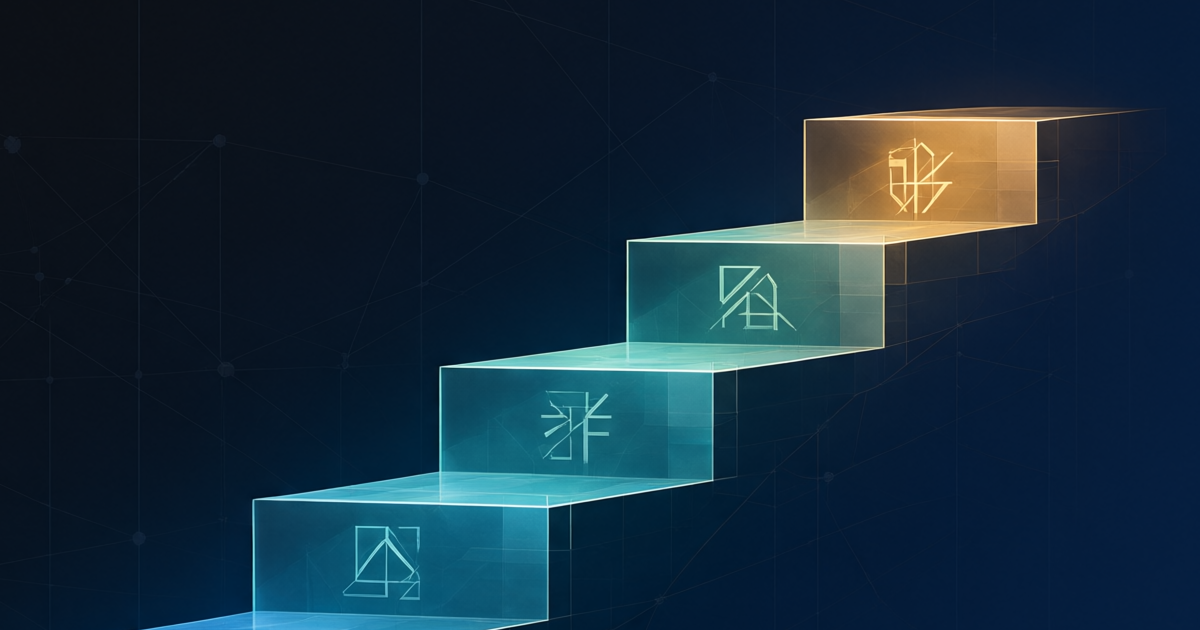
Stack the technical judgments from the briefing on top of the product moves already made and the fact-check results, and DeepSeek's next leg is fairly legible. Liang Wenfeng laid out an "AGI ladder" himself, and that is the skeleton of the forecast.
Liang Wenfeng's "AGI ladder": each rung stands on the one below
Prediction 1 (high confidence): a coding agent is the nearest product priority
He was unequivocal: "The most sensible approach is to go all in on a general-purpose agent; other agents (finance, doctors) are lower priority... At this stage the most important thing is still the coding agent." That matches what has already happened — in May 2026 DeepSeek publicly began recruiting a "Code Harness" team for a product codenamed "DeepSeek Code," with job descriptions explicitly benchmarked against Claude Code and Cursor. V4 was likewise designed for agent workloads (V4-Flash is positioned for high-frequency agent tasks). Expect a standalone, first-party DeepSeek coding agent within the next 6–12 months.
Prediction 2 (high confidence): natively multimodal next version and larger activation, on a two-to-three-month cadence
He said later V4 releases "will support native multimodality" — but stressed that "multimodality is a component, not the main line of intelligence itself," making it a service to consumer products rather than a trunk of the roadmap. On scale, he indicated the next generation could reach 150–250B active (benchmarked against a particular generation of frontier reasoning models), with training "optimistically starting late this year, more likely next year." The release cadence anchor is his own: "a version every two or three months." On that basis, the second half of 2026 should bring V4 out of preview plus a follow-up release with native multimodality, with activation scale climbing toward the hundreds of billions. (Note: the "next version by end of June" he predicted at the time actually slipped to mid-July, so cadence forecasts do wobble.)
Prediction 3 (medium confidence): training and inference shift further onto domestic silicon, tightly coupled to Huawei
The logic chain is tight: high-end NVIDIA cards are unobtainable → "everyone is forced into domestic substitution" → DeepSeek actively engages deep in Huawei's ecosystem and co-builds the TileLang compiler for Ascend adaptation. The corroborating evidence is already in: at V4's launch, Ascend, Cambricon, Hygon, and Moore Threads all shipped day-0 support. The constraint is Huawei's output — by his own account Huawei can supply only about 16,000 950s a year, "enough to train this generation, not enough for the next." Expect domestic chips to keep gaining share of DeepSeek's training and inference, but HBM and advanced-node capacity will prevent them from supporting its largest training runs in the near term.
Prediction 4 (medium confidence): API plus B2B carries it to positive cash flow, then an IPO around 2027
He set two floors: "a few hundred million dollars of B2B revenue this year plus consumer users puts the company not far from net profit"; and "worst case, going all in on selling API alone could sustain a public company." Add the second round reported by the FT (roughly $71 billion pre-money) and the rumored 2027 STAR Market IPO plan, and the commercialization path is clear: no chasing traffic, no ad spend, harvest a reasonable margin off the cost advantage built through open source, use B2B to turn cash flow positive, then go to the capital markets. He repeatedly stressed this is only "a byproduct done on the side" — AGI is the main line.
Prediction 5 (low confidence / long term): continuous learning is the biggest unknown
It is the one rung on his ladder where he admits "nobody in the world has found a method that works yet," and the mandatory gate on the way to the "self-iteration singularity." He has put half the company's core researchers on data annotation ("solving AI problems at this stage comes down to labeling data") and set the bar for defining the next-generation model at "must have continuous learning." This determines DeepSeek's ceiling, and it is also the least predictable part — no breakthrough date can be given; it could be six months or several years.
Confidence in the five predictions
Closing
The most memorable thing about this briefing is not any single startling number, but the way Liang Wenfeng turns "taking less" into a derivable competitive strategy: in a race where everyone believes the prize is enormous, he argues the winner is whoever wants the least, therefore meets the least resistance, and puts the probability of succeeding ahead of share. Whether that judgment is correct waits on AGI itself. But it is internally coherent, consistent with three years of his words and actions, and it survives most of the fact-checking.
For readers, the right posture is this: treat it as a highly credible but officially unratified primary source — accept his judgment on strategy and roadmap, while staying alert to unverified figures like "800B active" and compressed narratives like "V3 has already left the NVIDIA ecosystem."
Source material
The two primary documents behind this piece are below, so readers can check our quotations against the originals. Note: neither has been confirmed by DeepSeek, and the transcript contains identifiable recognition errors (model names in particular); the audio is authoritative where they conflict.
📄 Full recording transcript (PDF)
42 pages · full recording length 3 hours 44 minutes (deepseek 0520.m4a) · auto-transcribed by speech recognition, with timestamps. All quotations in this piece defer to this version.
📝 Thematically organized transcript (Markdown)
118 points · abridged and sorted into 11 themes. This article corrects several compression-induced distortions in it (TileLang, for one).
Sources
Every fact-check verdict here is cross-verified against the public sources below, listed so readers can re-check them.
The meeting and the funding backdrop
- CNBC, "DeepSeek slated to draw $7 billion in maiden fundraising," 2026-06-03
- Financial Times, reporting on DeepSeek's second funding round (roughly $71 billion pre-money) and STAR Market IPO plans, 2026-07
- QbitAI, "The investor list for DeepSeek's first funding round," 2026-05
- Yicai, Tencent Tech, 36Kr, Sina Finance: transcripts and coverage of the briefing, 2026-07-22/23
- Reuters (Beijing), citing Yicai's reporting on DeepSeek prioritizing AGI, 2026-07-23
- National Business Daily, reporting that the closed-door meeting was verified by participating investors, 2026-07-23
- Securities Times, Futu: Zhipu (02513.HK) listed in Hong Kong on 2026-01-08, used as a document time anchor
Compute and chips
- SemiAnalysis, "DeepSeek Debates" and "Huawei Ascend Production Ramp," 2025-02 / 2026
- CSIS, "DeepSeek, Huawei, Export Controls, and the Future of the US-China AI Race"
- Tom's Hardware: estimates of DeepSeek's GPU holdings, the Huawei Ascend roadmap, and Atlas 950 SuperPoD coverage, 2025-02 / 2025-09
- TrendForce: Huawei Ascend 950 specifications and day-0 support for DeepSeek V4 from Ascend, Cambricon, and Hygon, 2025-09 / 2026-04
- NVIDIA's official Blackwell (B200/GB300) FP8 compute specifications; technical breakdowns from Cudo Compute and Spheron
- DeepSeek-V3 technical report (arXiv:2412.19437): 2,048 H800s, CUDA + custom PTX
Models, technology, and commercialization
- DeepSeek's official news page and technical reports: V3.1 (first step toward the agent era), V3.2-Exp (DSA sparse attention + price cuts), V4 Preview (arXiv:2606.19348, 1.6T total params / 49B active, 1M context)
- DeepSeek, "DeepSeek-V3/R1 Inference System Overview," disclosing a 545% theoretical cost profit margin, 2025-03-01
- The Information, reporting DeepSeek's annualized revenue at roughly $400–500M, mid-2026
- The TileLang paper (arXiv:2504.17577) and the tile-ai/tilelang, DeepGEMM, and FlashMLA open-source repositories; led by Yang Zhi's team at Peking University, 2025
- DeepSeek's staged rollout of vision capabilities and the "Thinking with Visual Primitives" technical report, 2026-04-29/30
- Public reporting on DeepSeek's "Code Harness / DeepSeek Code" coding agent team recruitment, 2026-05
Liang Wenfeng's past remarks (the baseline for style comparison)
- Waves (36Kr), "The Madness of High-Flyer," 2023-05-24
- Waves (36Kr), "Inside DeepSeek: An Even More Extreme Chinese Technological Idealism," 2024-07-17
- The DeepSeek-R1 paper on the cover of Nature, with Liang Wenfeng as corresponding author, 2025-09-17
- DeepSeek's official "Statement on Official Information and Service Channels" (the 2025-02-06 debunking of the "fake Liang Wenfeng" incident), as a reference pattern for fabricated remarks
Note: this article is based on a circulating transcript of a recorded Liang Wenfeng investor briefing that DeepSeek has not officially confirmed. Every verdict marked "✓/≈/?" is cross-verified against the public sources listed above; specific figures involving internal procurement and revenue have no audited basis, are provided for reference only, and do not constitute investment advice. Copyright in the source material above belongs to its respective rights holders; it is cited here solely for verification and research.